Article
You have completed the NHS Evergreen Sustainable Supplier Assessment, submitted it through Atamis and received the result “No Level Awarded”.
What should you do now?
Start by finding out why you received that result. There may be a gap in your sustainability evidence, but that is not the only possibility. We have seen suppliers receive No Level Awarded because information was entered incorrectly in Atamis, and in one case because of a problem with the system itself.
That distinction matters. If your Carbon Reduction Plan is already suitable, rewriting it will not fix a missing link in Atamis. If your evidence and answers are both correct, changing either of them may not solve a system problem.
Here is how I would work through it.
Evergreen gives suppliers one of four maturity levels. Level 1 is the starting point, with Levels 2, 3 and 4 progressively adding wider carbon reporting, stronger Net Zero requirements, independent validation and verification, modern slavery requirements, transparency and supply-chain action.
No Level Awarded means that your completed assessment has not resulted in one of those four levels.
It does not, by itself, tell you what went wrong.
What that result means commercially depends on the procurement route. NHS Supply Chain requires suppliers submitting tenders from 6 April 2026 to have achieved Level 1 by tender close. For NHS England medicines tenders, an active Evergreen submission is currently required, but suppliers are not excluded solely because the assessment has not achieved a level.
Check the procurement documents you are working to and confirm the Evergreen requirement that applies to that tender or framework.
Then look at the result itself.
If you expected to achieve Level 1, this is the most useful place to start.
For the current Level 1 route, check that your Carbon Reduction Plan does all of the following:
If you are working towards Evergreen Level 2, you need to go further and report all relevant Scope 3 emissions, not only these five categories.
If you can see that one of these things is missing, you have found something worth correcting.
If the Carbon Reduction Plan looks sound, check what you actually entered into Evergreen next.
Want someone to check the evidence before you change it?
Our NHS Evergreen Evidence Review & Action Plan reviews the evidence you already have against the level you are working towards and identifies what genuinely needs attention.
A suitable Carbon Reduction Plan can still result in No Level Awarded if the information entered into Evergreen does not show what the document contains.
Go back through the assessment and compare your answers with the evidence itself. Check that:
That final point comes directly from experience.
One NHS supplier I supported already had a Carbon Reduction Plan that should have supported Level 2, but still received No Level Awarded.
The problem was much simpler. The assessment asked for the link to the Carbon Reduction Plan in more than one place, and the supplier had completed one of those fields but not the other. Once we traced the result back through the assessment, it was clear that rewriting the Carbon Reduction Plan would have achieved nothing. The evidence already existed; the missing information was in the assessment itself.
If your Carbon Reduction Plan appears to meet the criteria, compare the actual Evergreen answers against it before changing the underlying document.
There is one more possibility.
I have also worked with an NHS supplier whose evidence appeared to support Level 1 and whose Evergreen answers appeared to be correct, but the system still returned No Level Awarded.
We checked the evidence and the assessment and could not identify an obvious Level 1 gap. The issue ultimately had to be raised with the people responsible for the system because there appeared to be a software problem.
That does not mean you should assume there is a problem with the system. Check the evidence and your answers first. But if both stand up to scrutiny, it is reasonable to query a result that does not appear to follow from what you submitted.
You do not need to diagnose every detail yourself before asking for support. For many businesses, Evergreen is one requirement among many, and there may be little value in spending hours troubleshooting a system you only use occasionally.
The important thing is to understand what actually needs attention before you start creating or replacing evidence that may already be perfectly usable.
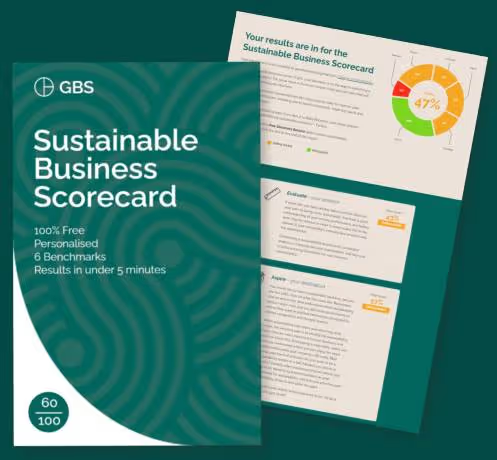
Discover your sustainability strengths and weaknesses with the Sustainable Business Scorecard.
Get My Sustainability ScoreGuide
Learn seven practical steps to put your sustainability plan into action, from activating owners and embedding change to measuring progress and maintaining momentum.
Article
Our food system is responsible for a third of all carbon emissions and half of net deforestation. To meet our climate and biodiversity targets we need to make food sustainable.
Guide
Stakeholders are vital to the success of any business. Find out how to identify and prioritise them with our easy how-to guide.
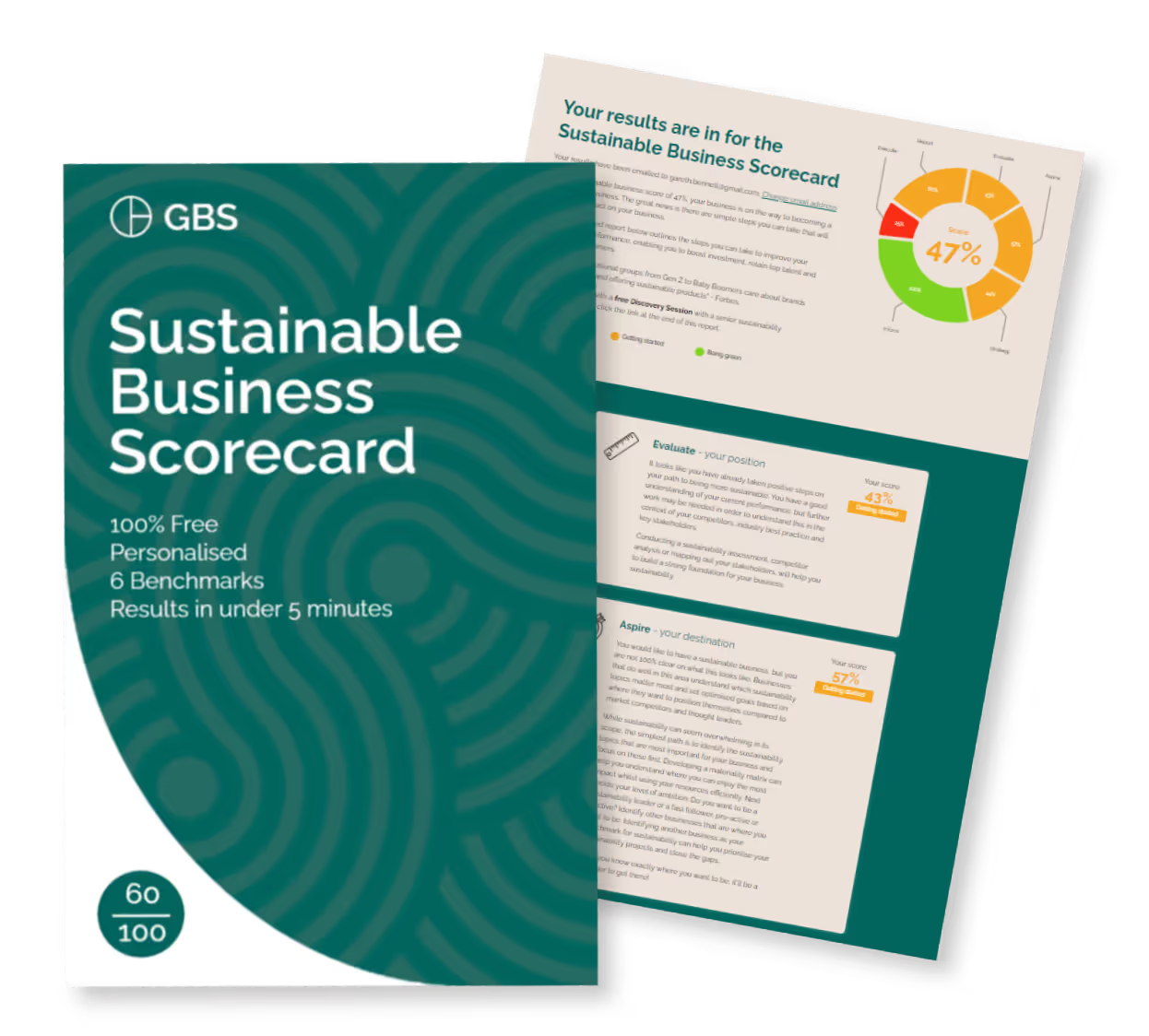
Our Sustainability Scorecard helps businesses quickly assess their current sustainability performance across key ESG topics.
In less than five minutes, you'll receive:

A sustainability rating
Practical recommendations
Identification of key strengths
A clearer sustainability roadmap
Areas for improvement

Instant results. No credit card required.


