Guide
Developing a sustainability plan creates direction. It establishes what the business wants to achieve, which actions it intends to take and who should contribute. The results only begin to appear when those decisions change how the business operates.
Many small-business leaders reach the same question once their plan is approved: how do we implement a sustainability plan while keeping the rest of the business moving?
People need to know what they are responsible for, have what they need to act and understand how progress will be managed. Work crossing different teams and suppliers must be coordinated. Leaders also need enough information to make decisions, address problems and maintain momentum.
Putting those arrangements in place involves seven connected steps. Before working through them, check that the business and its people are ready to begin.
Circulating the plan and assigning deadlines rarely creates sufficient readiness on its own. The people affected need to understand the priorities, what those priorities mean for their work and where they can obtain guidance or raise practical concerns.
This preparation sits within the Involve stage of EASIER™. Every possible question need not be answered before work begins. The business needs enough shared understanding for people to act deliberately rather than improvise blindly.
If employees understand the overall strategy but cannot explain what it changes in their roles, further preparation may be needed. Our article, Why Sustainability Strategies Stall After Launch, explains how to identify and address that gap.
Once the plan is sufficiently clear and the people affected are ready to contribute, the business can move into implementation.
A long sustainability action plan can create the impression that everything should begin immediately. Starting too many actions at once can spread attention and resources so thinly that little meaningful progress is made.
Begin by deciding which actions should start first. These might be immediate priorities, early milestones or enabling actions that allow other parts of the plan to proceed. Establishing a carbon baseline, approving an ethical-sourcing policy or creating a process for collecting supplier information could each unlock several later actions.
The people responsible for the initial actions must then become active owners. Naming someone in the plan assigns responsibility. Active ownership begins when that person understands the expected outcome, accepts responsibility and has the authority and resources to act.
For each initial action, confirm:
This turns a list of intentions into work that can begin. It also exposes problems early, while the business can still resolve them before they delay the wider plan.
Sustainability remains vulnerable when it depends on a separate action tracker competing with day-to-day priorities. Lasting implementation requires the relevant actions and requirements to become part of normal business activity.
What this involves will depend on the priority. An ethical-sourcing commitment may need to appear in labour standards, supplier selection criteria, contracts, performance reviews and routes for workers to raise concerns. A carbon-reduction objective might affect investment decisions, maintenance plans, travel policies and budgets. A packaging target may need to become part of product development and approval.
Use existing management systems wherever practical. Review where current policies, procedures, meetings, budgets and decisions need to change, rather than automatically creating a parallel system for sustainability.
Role-specific guidance and training may also be needed. General awareness can help people understand why a sustainability priority matters, but implementation requires them to perform their part of the changed process. Procurement colleagues may need new supplier questions. Finance colleagues may need guidance on assessing sustainability investments. Operational teams may need revised procedures and practical instruction.
Training should respond to a genuine knowledge or competence need. It cannot compensate for unclear responsibilities, missing authority or insufficient resources.
Sustainability plans frequently cross departmental and organisational boundaries. One person may own an action but depend on information, approval or practical work from several others.
Reducing supply-chain emissions, for example, could require procurement to engage suppliers, finance to approve expenditure, operations to assess alternatives and suppliers to provide reliable data. Each participant might complete an individual task while the overall action still fails because the dependencies and handovers have not been managed.
For each priority, identify potential dependencies such as:
Someone should maintain visibility across these connections. This might be a sustainability lead, programme manager or another appropriate coordinator. Coordination connects the work, identifies conflicts and escalates barriers while operational owners remain responsible for delivery in their areas.
This distinction prevents sustainability from gradually becoming one person’s job simply because that person coordinates the overall plan.
Businesses need information during implementation, not only when preparing a future sustainability report. Without proportionate measures, it is difficult to distinguish genuine progress from a collection of completed activities.
Three types of indicator provide different parts of the picture:
These categories are distinct when each indicator is assigned according to the question it answers. Together, they show whether the business is completing the work, changing performance and achieving the intended result.
Not every action needs an extensive collection of key performance indicators. Each measure should help someone understand progress or make a decision. If nobody can explain what they would do differently because of a measure, it may not deserve a place on the scorecard.
The appropriate information and frequency also depend on the audience. An action owner may need regular feedback on whether a change is working. People responsible for buying or operating processes may benefit from timely indicators showing whether their actions are making a difference. Managers may need periodic information focused on milestones and exceptions. Senior leaders generally need a smaller set showing material progress, risks and decisions.
Relevant feedback can also support motivation by making progress visible and connecting day-to-day actions with the wider result the business is trying to achieve.
For every important measure, confirm:
A useful dashboard is the smallest reliable set of information that enables the business to act. Larger scorecards can consume considerable time without improving decisions.
Information becomes useful when leaders and action owners use it to decide what happens next.
Create a proportionate review rhythm for the plan. Some actions may need frequent operational checks, while leadership may only need to review the wider programme monthly or quarterly. Timing should reflect the pace, importance and risk of the work.
A useful progress review should establish:
Problems should normally be resolved at the lowest level with sufficient authority. Escalation becomes necessary when the owner cannot resolve a resource constraint, cross-functional conflict, material risk or question affecting the feasibility of the plan.
Record important decisions and changes. This creates continuity and helps the business distinguish deliberate adaptation from unmanaged drift.
Even a well-designed sustainability plan will encounter delays, mistakes and unexpected barriers. Effective implementation identifies and responds to these problems before they become permanent features of the programme.
When an action is delayed or a requirement is not followed, begin by understanding what happened. Was the requirement clear? Did the person have sufficient guidance, competence, authority and resources? Was the issue an isolated mistake, repeated behaviour or a weakness in the wider system?
Correcting the immediate problem may only provide a temporary answer. The underlying cause might require a changed procedure, a resolved bottleneck, clearer decision rights, better training or a redesigned method of collecting information.
Stakeholder feedback can be particularly valuable here. Employees, suppliers and other affected groups may see barriers that are invisible in a dashboard. Their experience can reveal conflicting priorities, impractical requirements, unintended consequences or incentives that encourage people to continue working in the old way.
Businesses can also look for ways to accelerate delivery. Proven templates, sector guidance and existing management standards may remove the need to design everything from scratch. Appropriate automation can reduce the time spent requesting data, chasing updates and maintaining evidence.
Improvement should make implementation more effective and reliable. Any added complexity should earn its place by improving control, reducing effort or producing a better result.
A burst of activity after launching a sustainability plan does not guarantee lasting change. Progress can fade when leadership attention moves elsewhere, trained employees leave or temporary project arrangements end.
Making the change stick means incorporating the successful approach into the organisation’s established way of working. Responsibilities and process ownership should remain clear. Guidance, induction and training may need to be refreshed. Controls and review arrangements must continue after the initial action has been completed.
Businesses should capture what worked, standardise useful improvements and recognise meaningful progress. Visible progress builds confidence that the plan is achievable and can encourage further participation.
Evidence should also be retained. Records of actions, decisions, measures, problems, stakeholder feedback and corrective action will help the business evaluate and report what happened. Completing an activity does not prove that it achieved the intended impact, but good implementation records make that assessment possible.
Stakeholder engagement continues throughout implementation.
Action owners can explain what prevents progress. Employees can identify where a new requirement conflicts with established ways of working. Suppliers may reveal unrealistic timescales or missing support. Customers and other affected groups can help the business understand whether intended changes are producing the expected result.
This feedback complements formal performance information. Measures show what is happening; engagement can help explain why.
Proportionate engagement focuses on the people who can inform a decision or who are materially affected by it. The business should provide practical ways for them to contribute, raise barriers and challenge assumptions throughout delivery.
If you are unsure whose experience should inform implementation, our guide to stakeholder mapping provides a practical starting point.
Most small businesses can put a sustainability plan into action using meetings, budgets, action trackers, procedures and reporting arrangements they already have.
The resulting system should be proportionate to the plan. It needs to provide enough ownership, coordination, information and control for the business to understand what is happening and act when needed.
Begin with the smallest workable approach. It can develop as the plan, available evidence and the organisation’s capability mature.
Some businesses can manage these steps internally. Others may have a sound plan but lack the time, systems or specialist capacity needed to put it into practice.
Implementation support can help convert planned actions into defined work, establish ownership and integrate requirements into existing processes. Programme coordination may be useful where several teams, suppliers and dependencies need to remain aligned. Role-specific training can address genuine knowledge or competence gaps identified during mobilisation and delivery.
The appropriate support depends on the barrier. Sometimes the most useful intervention is clearer responsibility, a better process, a management decision or a simple review rhythm. More substantial support becomes valuable where the business lacks the capacity or expertise to establish and manage those arrangements itself.
Choose one important priority from your sustainability plan and ask:
The first unclear answer is likely to show where implementation needs attention next.
If you would like help putting your sustainability plan into action, get in touch to discuss what is holding progress back and the most useful next step.
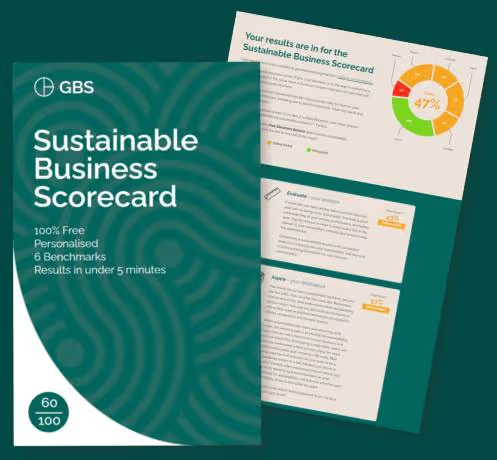
Discover your sustainability strengths and weaknesses with the Sustainable Business Scorecard.
Get My Sustainability ScoreArticle
Your competitors can help you understand your sustainability performance. But the best organisations to compare with may not be the best ones to learn from.
Article
Received No Level Awarded in the NHS Evergreen Assessment? It may be an evidence gap, an Atamis issue or an unexpected system result. Here’s how to work out what needs attention.
Article
Sustainability is not just for large international corporations. Small businesses have a big impact. Here's how to make your impact a positive one.
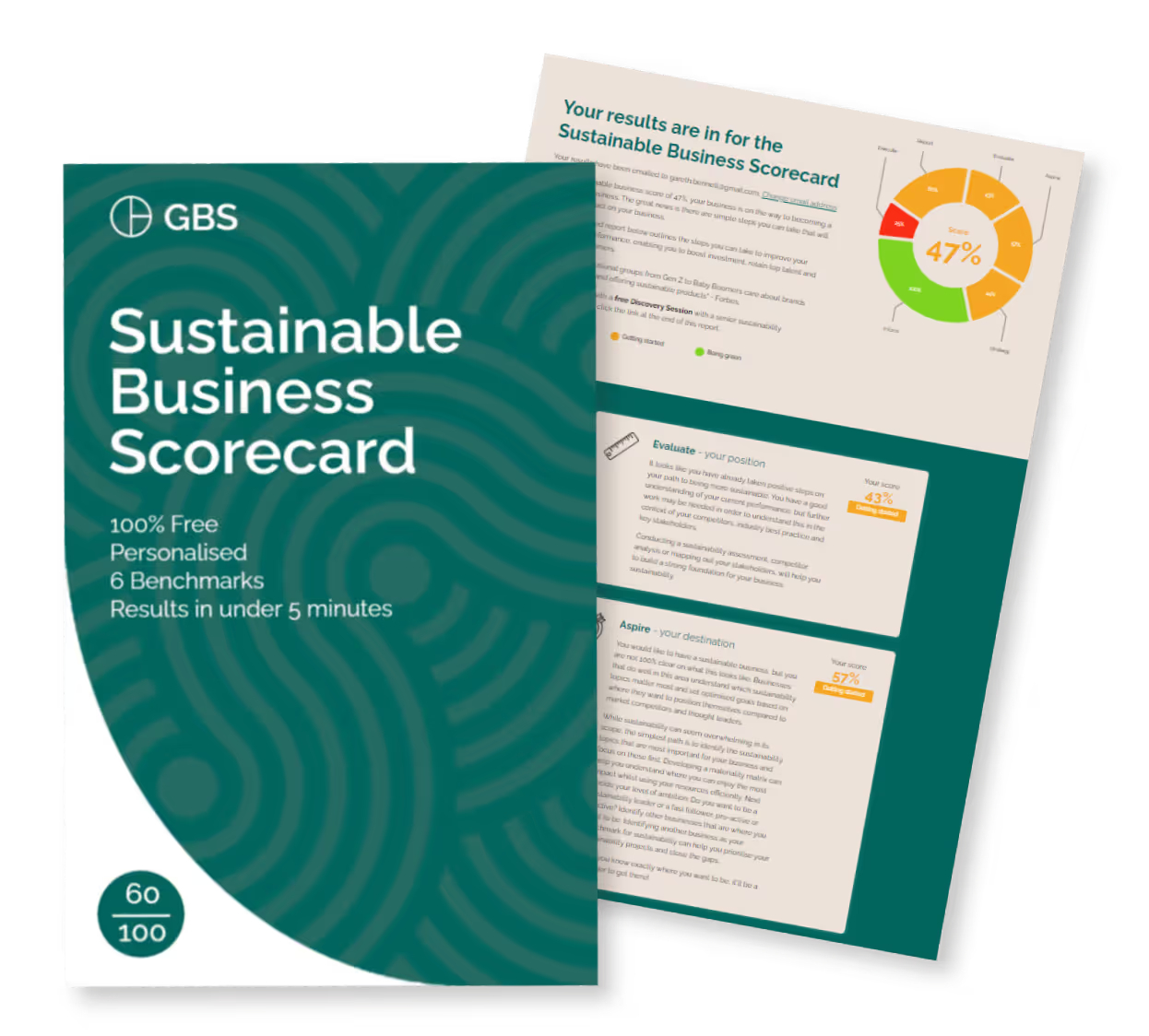
Our Sustainability Scorecard helps businesses quickly assess their current sustainability performance across key ESG topics.
In less than five minutes, you'll receive:

A sustainability rating
Practical recommendations
Identification of key strengths
A clearer sustainability roadmap
Areas for improvement

Instant results. No credit card required.


